Enterprises use unmanned aerial vehicles (UAVs) for inspection, monitoring, emergency support, mapping, and other large-area tasks. Yet adding aircraft does not automatically improve operations. Teams must coordinate routes, payloads, communications, data, and mission priorities.
An integrated drone swarm connects autonomous coordination, onboard intelligence, and centralized control. This article explains how enterprises can evaluate a drone swarm solution.

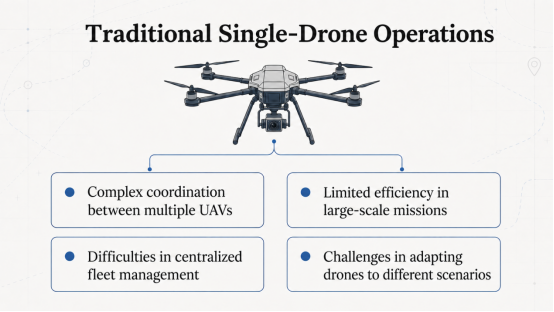
Why Traditional Single-Drone Operations Fall Short
Single-drone operations work for limited tasks, but they become harder to scale across large or time-sensitive missions.
- Complex CoordinationBetween Multiple UAVs: UAV swarm technology operations become difficult when routes, timing, and task priorities must be coordinated manually across several aircraft.
- Limited Efficiency in Large-Scale Missions: Without a coordinated drone swarm system, overlapping routes, uneven task allocation, and coverage gaps can lead to repeated flights.
- Difficulties in Centralized Fleet Management:Drone fleet management becomes difficult when aircraft status, communication links, payload data, system alerts, and mission progress are spread across separate interfaces.
- Challenges in Adapting Drones to Different Scenarios:Redeploying enterprise drones becomes difficult when each mission requires different aircraft, payloads, routes, and operating parameters.
Key Criteria for Choosing a Drone Swarm System
For enterprise drones, fleet size alone does not determine operational value. Effective drone swarm technology must coordinate aircraft while maintaining reliable data flow, secure communications, and usable outputs.
- Autonomous Coordination: Core capabilities include task allocation, route planning, and dynamic path optimization across multiple UAV
- Edge AI Processing: Onboard computing enables mapping and perception data to be processed during flight, reducing dependence on external ground computing.
- Integrated Air-Ground Operations: Onboard intelligent units, UAV collaboration networks, and ground terminals work together to connect mission planning, data collection, processing, and result output.
- High-Precision Output:Reliable operation depends on precise mapping, target positioning, change detection, and moving-object recognition.
- Secureand Scalable Management: Drone fleet management support centerless networking, encrypted communication, and multi-node connectivity for coordinated operations.
How IceCypress BeeSmart Supports Enterprise Requirements
IceCypress BeeSmart is an integrated hardware-software platform for large-scale mapping and reconnaissance. This UAV swarm technology architecture combines onboard intelligent units, a UAV collaboration network, and a portable ground terminal to connect mission planning, aerial collection, onboard processing, and result output.
Efficient Multi-Drone Collaboration for Large-Scale Missions
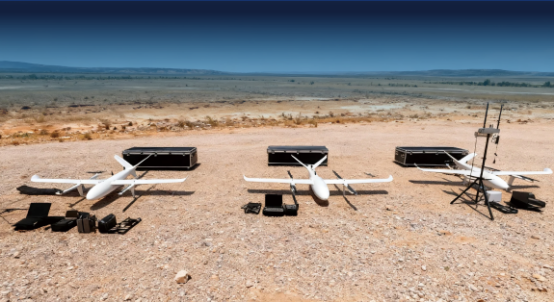
BeeSmart supports heterogeneous fixed-wing and multirotor fleets. It completes task allocation and route planning for more than 30 drones within one minute, with dynamic path optimization, helping distribute large-area missions efficiently.
Real-Time Onboard AI Processing
The onboard AI unit provides at least 275 TOPS and integrates visual SLAM with photogrammetry workflows. BeeSmart generates 2D and 3D models and digital orthophoto maps during flight, reducing reliance on external ground computing and offline post-processing for these outputs.
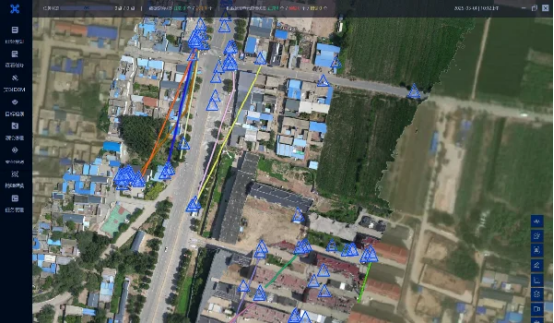
Complete Air-Ground Intelligent Operation Architecture
The platform combines onboard intelligent units, a UAV collaboration network, and a portable ground terminal. This architecture integrates data collection, onboard processing, mission coordination, and drone fleet management within one workflow.
High-Precision Mapping and Intelligent Perception
BeeSmart provides centimeter-level mapping output, sub-meter positioning for time-sensitive targets, and change-detection accuracy of at least 95%.
It detects and identifies moving targets in seconds and can track at least 20 objects simultaneously, with recognition accuracy of at least 80%.
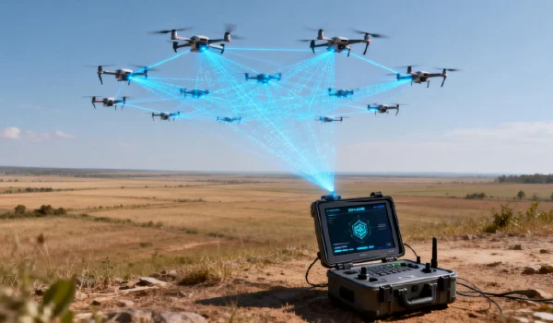
Stable Communication for Enterprise-Scale Deployment
BeeSmart uses a centerless mesh ad hoc network supporting up to 32 nodes, triple encryption, and line-of-sight air-to-ground transmission up to 100 km.
Major Applications of Drone Swarm Technology
These systems are most relevant where missions cover broad areas, repeat routes, or expose personnel to difficult environments.
- Infrastructure Inspection: Coordinated UAVs can divide bridge, corridor, construction, or asset-inspection routes.
- Emergency Response and Public Safety: Multiple aircraft can collect imagery, map affected areas, and support situational awareness.
- Smart City Management: A coordinated aerial fleet can support urban mapping, construction monitoring, land-use review, and change surveys.
- Industrial and Energy Operations:Visible and thermal payloads can support inspections of power infrastructure and oil-and-gas facilities.
- Agriculture and Environmental Monitoring: UAV swarm technology can distribute crop surveys, vegetation mapping, wildlife observation, and environmental data collection.

Conclusion
Choosing a drone swarm requires more than operating several UAVs. Enterprises should evaluate coordination, onboard processing, data accuracy, communications, and scalability as one system.
IceCypress BeeSmart integrates these functions for mapping and reconnaissance. Enterprises can assess the BeeSmart drone swarm system against their aircraft, payloads, environment, and mission requirements.
FAQs
- What industries can benefit most from drone swarm technology?
Infrastructure, energy, public safety, mapping, agriculture, and environmental monitoring can benefit from coordinated UAV coverage.
- How many drones can an enterprise drone swarm system manage?
Capacity depends on the system configuration and deployment requirements. BeeSmart can complete task allocation and route planning for more than 30 drones within one minute. Its separate 32-node specification refers to mesh network nodes, not a stated maximum fleet size.
- What features matter in drone fleet management software?
Key features include mission planning, task allocation, aircraft status monitoring, communication management, payload integration, and data output. BeeSmart combines these functions with onboard processing and coordinated air-ground operations.
- How can enterprises start implementing a drone swarm solution?
Enterprises should begin with a defined use case, confirm aircraft and payload requirements, review regulatory conditions, and run a controlled pilot. BeeSmart can then be evaluated against the required mission scale, data accuracy, and communication range.