Achieve seamless real-time synchronization between physical infrastructure and its digital twin — enabling precision monitoring and control across the entire water supply chain, while driving measurable cost reduction and operational efficiency gains.
Industry Pain Points
Water utilities often manage GIS, pipeline, equipment, and operational data across separate systems. Limited integration makes it harder to maintain a shared view of network conditions, access relevant records, and coordinate responses across departments.
Monitoring, alerts, work orders, and historical records may be managed through separate workflows, making it harder to track issues from detection through resolution. Consistent performance indicators and accessible operational records help teams review recurring problems and monitor service performance.
Dense equipment networks and interconnected pipelines create demanding inspection and maintenance requirements. When asset records, operating status, and maintenance histories are difficult to access together, teams may spend more time locating issues, reviewing equipment conditions, and coordinating repairs.
When monitoring, water-quality, pumping, and maintenance systems operate independently, relevant information may not be available within one workflow. This can slow operational adjustments, complicate performance analysis, and make coordination across teams more difficult.
Built on a 3D digital twin foundation, the platform combines BIM models, IoT device data, GIS layers, and AI-assisted analysis in a shared view of water infrastructure. It supports asset visualization, equipment status monitoring, spatial queries, alert review, and operational coordination. Data synchronization depends on the connected systems and configured update frequency.

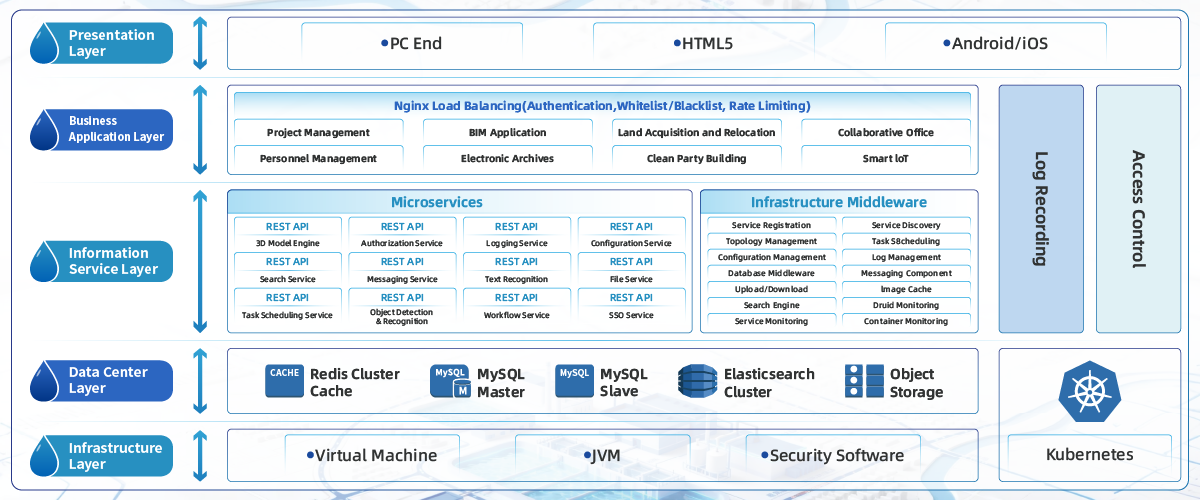
Our digital water management platform is built on five core layers, delivering enterprise-grade stability for smart city water management:
| Layer | Components |
| Presentation Layer | Multi-terminal access across PC, HTML5, and mobile |
| Business Application Layer | Project management, BIM applications, and Smart IoT |
| Information Service Layer | Microservices architecture with REST API integration |
| Data Center Layer | Redis cache, MySQL clusters, and Elasticsearch |
| Infrastructure Layer | Virtual machines, JVM, and Kubernetes orchestration |
Solution Highlights
A shared 3D environment brings together spatial models and connected operational data, helping teams review water infrastructure, equipment, and network conditions from a common interface.
For connected systems, the platform links selected equipment and network data to corresponding digital models. Teams can review operating status and use supported simulation tools to assess scenarios and prepare operational responses.
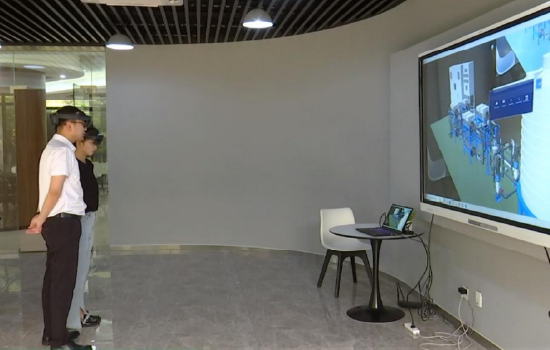
The platform brings together asset information, safety workflows, 3D navigation, and emergency-drill scenarios to support coordination across relevant stages of water utility operations.
IoT monitoring, operational data analysis, and simulation can support risk assessment and scheduling decisions. Recommendations and automated control actions depend on the deployed models, system integrations, and configured operating rules.
A modular architecture and reusable component library support project-specific configurations and phased expansion as new applications, data sources, and operational requirements are introduced.

Data Visualization: Presents trends through dynamic charts, 3D BIM models, and GIS maps.
Spatial Queries: Supports key-area labeling and interactive queries for buildings, assets, and equipment.


Equipment Management: Organizes equipment by facility zone and category, providing access to operating status, historical data, and maintenance records.
Anomaly Detection: Applies configured machine-learning models to connected operational data to flag potential abnormalities.
Alert Management: Filters alerts by configured conditions and severity, with notifications through supported channels such as SMS, email, and mobile apps. Links alert locations to the 3D environment to support review and follow-up.
Route Planning: Supports AI-assisted route generation and 3D path visualization, with scheduled and priority-based inspection modes.
Data Synchronization: Supports inspection-result uploads through WebSocket connections where configured, keeping task records available for review.
Inspection Records: Generates inspection reports and activity records to support retrospective analysis, issue tracking, and maintenance follow-up.


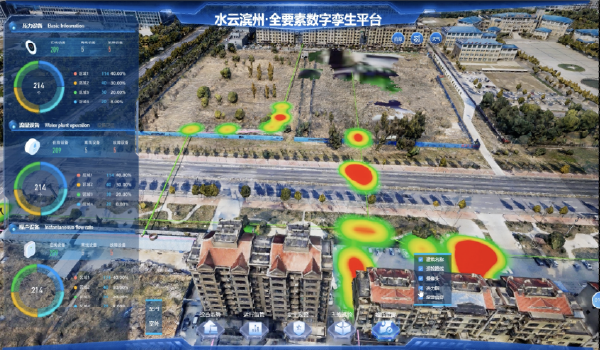
Work Order Visualization: Uses a heat map and status-based icons to display work-order distribution, including pending, in-progress, and completed tasks.
Work Order Tracking: Provides direct access to work-order details and updated progress information, supporting resource allocation and coordination across maintenance teams.

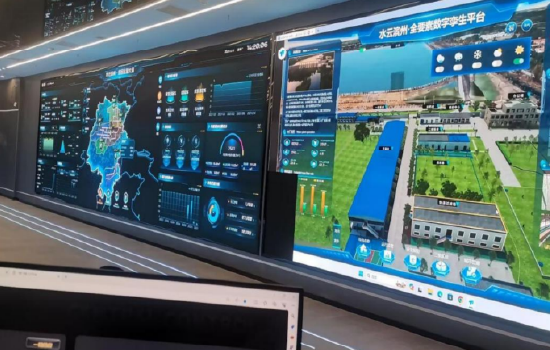
Shuiyun Binzhou: Water Utility SaaS Platform & Digital Twin Project. Jointly developed with Binzhou Water Group, the project combines a water utility SaaS platform with digital twin capabilities to support integrated supervision, operations, and management.

Selected as a 2024 Typical Smart Water Utility Case by the Ministry of Housing and Urban-Rural Development (MOHURD).

“Pipeline visualization and monitoring help our team review network conditions and coordinate maintenance more efficiently.”
Our digital twin water treatment platform synchronizes physical treatment systems with their digital models in real time — reflecting live equipment status and network conditions. Operators can run "what-if" simulations for contingency planning before issues arise, helping prevent downtime and maintain consistent water quality standards.
Our data-driven solutions for water management aggregate multi-source operational data into a panoramic digital cockpit — turning fragmented records into actionable insights. By automating KPI tracking, predicting equipment failures before they happen, and optimizing scheduling strategies, utilities typically see significant reductions in manual labor costs and unplanned downtime.
Yes. Our solution is purpose-built for water lifecycle management — from source monitoring and treatment supervision to distribution network control and maintenance tracking. Safety management, asset control, emergency drills and 3D roaming are all integrated into a single platform, eliminating the blind spots that come with fragmented tools.
Deployment timelines vary by project scale, but our digital water management platform is designed for efficient rollout. The standardized component library enables fast scenario deployment, and the modular microservices architecture means new functions can be added without disrupting existing operations. We recommend contacting our team for a project-specific assessment.
Our intelligent water management system combines IoT monitoring, big data analytics and hydraulic simulation to predict operational risks before they escalate. The system auto-generates optimal scheduling strategies and links digital decisions directly to physical control actions — reducing human error and improving response speed.
Share your application, project environment and technical requirements.
Follow Us :

Visual spatial intelligence for mapping, reconstruction and analysis.
Copyright © 2026 ICE CYPRESS. All rights reserved.