Hunter Wing: Single-Operator UAV Mapping & Target Detection System
Hunter Wing is a lightweight, single-operator UAV intelligence system that combines real-time orthomosaic mapping, AI target detection and precise positioning during flight.
Pain Points
Where conventional UAV workflows slow field operations
Conventional field mapping setups can require additional equipment, vehicles and personnel, making deployment more difficult in remote or hard-to-access terrain.
Complex setup, system integration and training requirements can slow deployment when teams need to respond quickly in the field.
Many UAV workflows rely on post-flight processing before maps and analysis results are available, creating delays in time-sensitive operations.
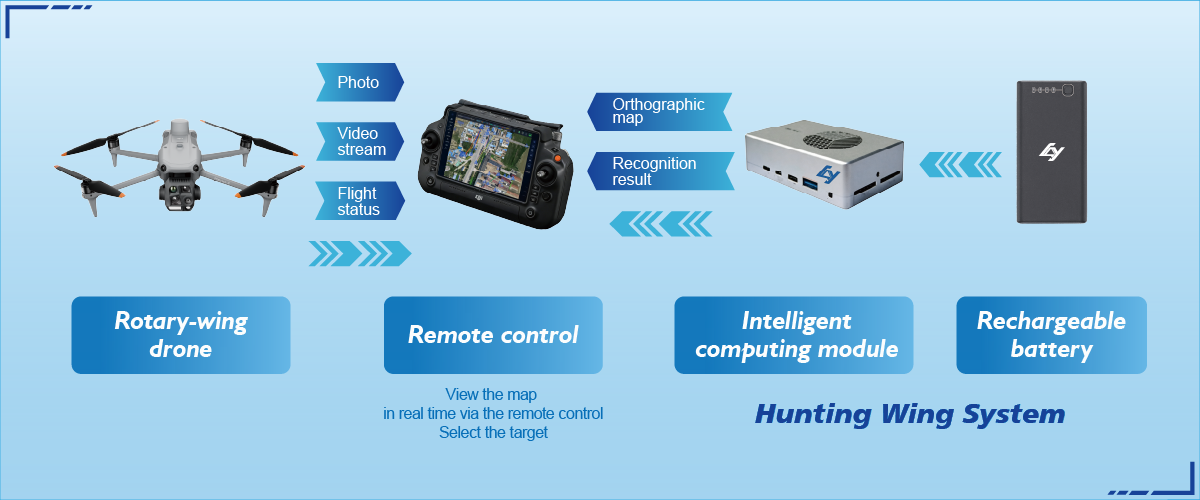
Hunter Wing integrates real-time orthomosaic mapping, AI target detection and precise positioning in a lightweight system designed for single-operator field deployment. It connects to supported industrial UAV remote controllers through the Hunter Wing Computing Box, enabling teams to access mapping and target information during flight without modifying the aircraft.
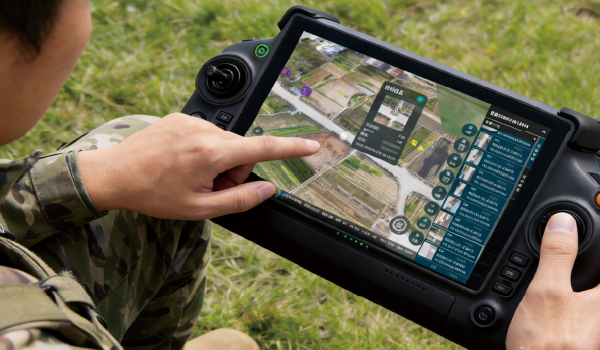
Connect the Hunter Wing Computing Box to the remote controller to enable real-time mapping, target detection, positioning and result display during flight.
Built for emergency response, security inspection, environmental monitoring and other field operations where teams need spatial information without waiting for post-flight processing.

Solution Highlights
Hunter Wing adds real-time mapping and AI analysis to supported UAV workflows while keeping deployment lightweight and simple.
The computing module and power supply weigh less than 600 g combined, reducing the additional load for mobile field deploymen
Designed to work with supported DJI industrial UAV platforms. Connect the Computing Box to the remote controller and complete setup in three steps: power on, connect and set the flight route.
The computing module consumes less than 25 W and supports up to 4 hours of continuous operation with the specified 24 V, 2000 mAh power source.
Mapping, target detection and positioning run during flight, with results continuously returned to the ground side for live review and mission-end use.

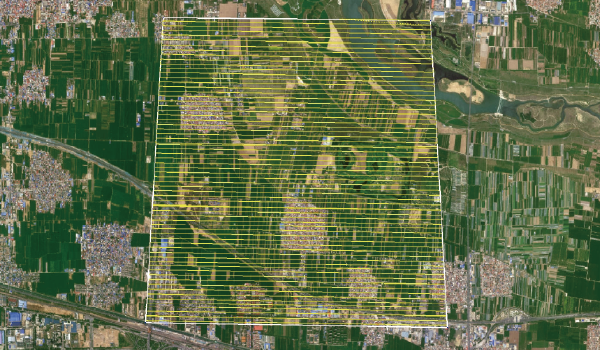
Generate an orthomosaic during flight and view the mapped area on the ground side as the mission progresses, reducing dependence on post-flight processing.
Designed for single-operator field deployment, with mapping results available during the mission for faster situational assessment.
Built-in drone object detection algorithms identify configured targets such as people, vehicles, and other objects of interest, with a detection response time of ≤0.5 s under supported conditions.
Detection results can include target count, category and confidence information, helping operators review and organize mission results more efficiently.


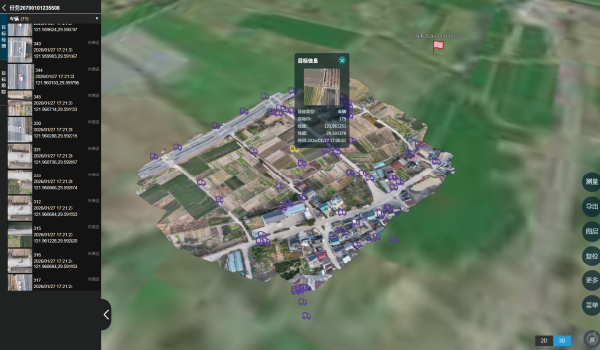
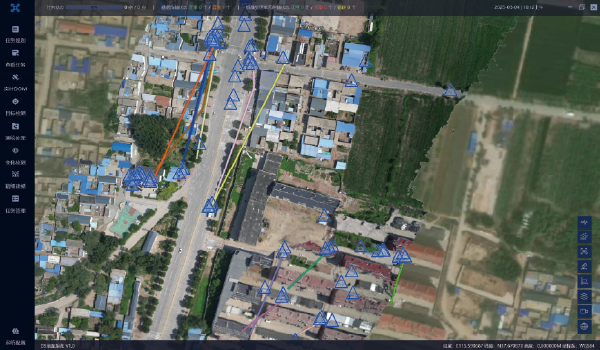
Display detected targets with geographic coordinates directly on the orthomosaic, allowing operators to identify both what has been detected and where it is located.
Supports sub-meter-level target positioning under specified operating conditions, providing geographic references for field verification and response.
During operation, imagery, mapping results, target detections, and location data are streamed to the ground station in real time for live monitoring.
Mission results can be uploaded to the cloud platform or exported for downstream analysis, archiving, reporting, and system integration.

The Hunter Wing Computing Box provides the processing required for real-time mapping, target detection, positioning and data return. Key system specifications are shown below.
| Parameter | Specification |
| Add-on Weight (Computing Module + Power Supply) | < 600 g |
| Power Consumption | < 25 W |
| Power Source | 24 V, 2000 mAh Mobile Battery |
| Continuous Operation Time | Up to 4 Hours |
| Target Detection Response Time | ≤ 0.5 s |
| Positioning Accuracy | Sub-meter Level |
| Deployment Steps | Power On → Connect → Set Flight Route (3 Steps) |
| UAV Compatibility | Multiple DJI Industrial UAV Series |

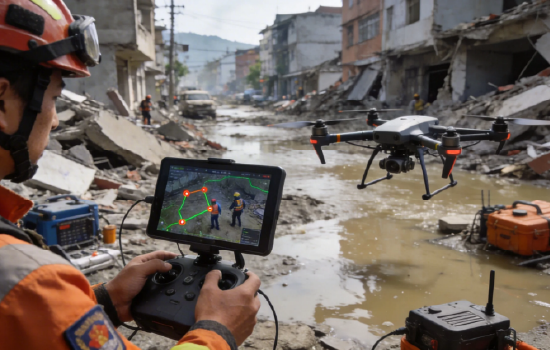
Generate live orthomosaic maps and locate people, vehicles or points of interest during floods, earthquakes and other emergency missions to support faster situational assessment and field response.

Map and monitor rivers, forests and protected areas while detecting configured objects or points of interest and recording their locations for field review.

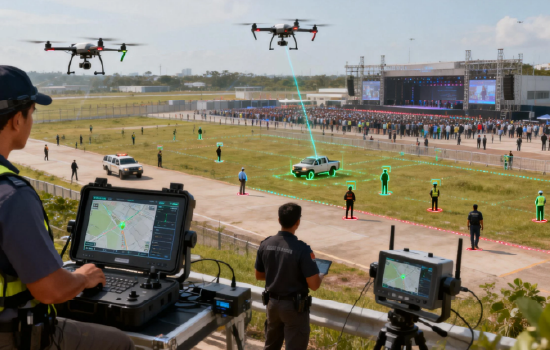
Support patrols across large or difficult-to-access areas by detecting configured people, vehicles or other targets and displaying their locations on the live map.

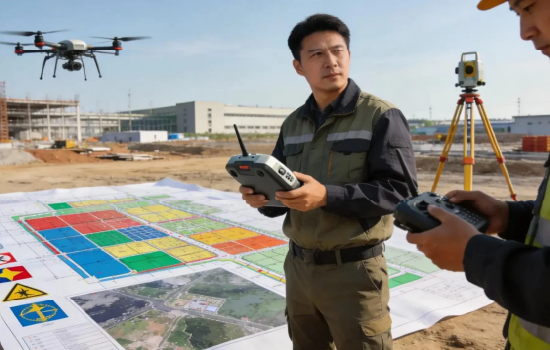
Generate up-to-date site maps during flight to support field review, progress monitoring and coordination across construction projects.
The onboard computer (AI Computing Box) is deeply compatible with multiple DJI industrial drone series, so most teams can connect it directly to their existing remote controller without modification. Deployment takes only three steps: power on, connect, set the flight route. If your fleet uses a different platform, reach out to us to confirm compatibility.
Position data is captured with sub-meter-level accuracy and overlaid directly on the orthomosaic imagery, allowing operators to track how a target's location changes throughout the mission. This level of precision is designed to meet the requirements of rescue, security, and monitoring scenarios rather than rough estimation. Results stream to the ground station in real time, so decisions don't wait until landing.
Mapping, recognition,, and positioning results can be uploaded to the cloud center and flexibly exported for downstream analysis, archiving, or reporting. Since processing happens onboard during flight, there's no offline processing step waiting for you after landing. Feel free to contact us; Our team is happy to help you.
No — the system is designed for personnel without specialized training, with deployment limited to three steps: power on, connect, and set the flight route. There's no hardware modification involved either. This is part of why it's suited to time-sensitive missions where waiting for trained operators isn't an option.
Not quite — Hunter Wing tracks targets as part of field mapping and recognition, not high-speed motion analysis. For sub-pixel, lab-grade motion tracking, see TrackSight instead.
Hunter Wing focuses entirely on what's on the ground — people, vehicles, hazard points — not on broadcasting the aircraft's own identity. That's a different function, sometimes called remote identification of drones, which falls outside the scope of this system.
Share your application, project environment and technical requirements.
Follow Us :

Visual spatial intelligence for mapping, reconstruction and analysis.
Copyright © 2026 ICE CYPRESS. All rights reserved.