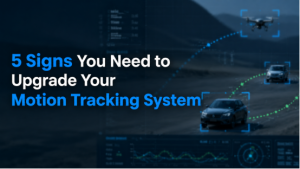
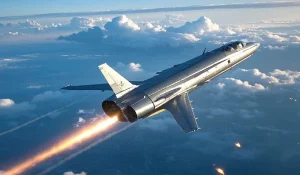
Motion tracking is becoming essential in aerospace, defense, advanced manufacturing, and biomechanics. Markerless motion tracking is also gaining wider adoption because AI-based recognition can track unmarked targets without requiring physical markers, reducing preparation in suitable test scenarios.
Yet many teams still rely on equipment that cannot meet current expectations for speed, accuracy, range, and data integration.
These five signs can help determine whether your motion tracking system is now limiting test performance.
Sign 1 — Losing Track of Fast-Moving Targets
A traditional object tracking system may lose lock when a target accelerates, becomes partially blocked, encounters glare, or appears at low resolution. Even brief tracking gaps can result in incomplete position, velocity, or orientation data.
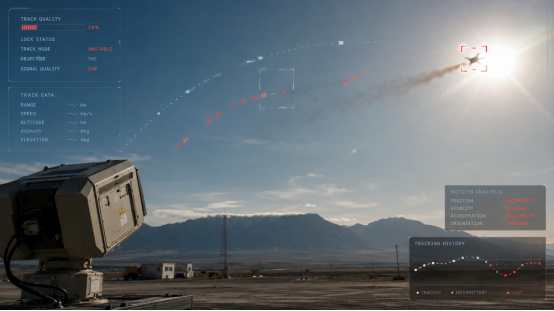
Modern high speed motion analysis benefits from a motion tracking system that combines sub-pixel accuracy with reliable performance under partial occlusion, sudden lighting changes, glare, and low-resolution conditions.
Sign 2 — Manual Calibration Eating Up Test Time
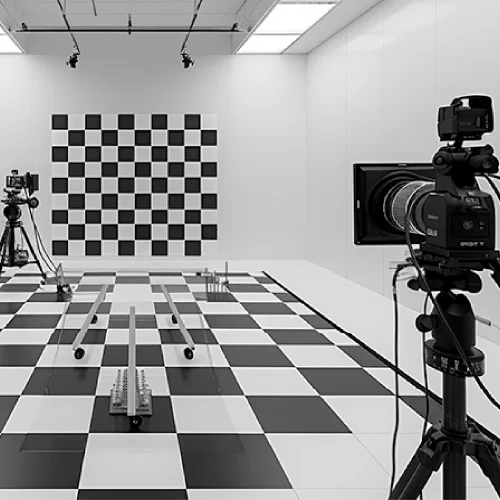
Some conventional calibration workflows require repeated marker placement, manual measurements, or specialist adjustment, increasing preparation time across laboratory, outdoor, and aerial tests.
An upgraded motion tracking system should support multiple calibration methods for different layouts, environments, and measurement distances. Telephoto-lens calibration and UAV RTK-assisted positioning can support long-range and aerial tests, while markerless motion tracking reduces target-preparation requirements when attaching dedicated markers is impractical.
Sign 3 — Accuracy That No Longer Meets Your Standards
Aerospace and other high-speed testing applications increasingly require more than approximate position data. Teams may also need to measure target orientation, rotation, deployment, and deformation.
A modern motion tracking system should combine sub-pixel trajectory measurement with six-degree-of-freedom pose calculation. Low attitude error improves validation, while motion analysis software can extract contours in real time to measure area, volume, deployment speed, and deformation.
Sign 4 — Limited to Short-Range or Single-Camera Setups
Single-camera-only setups provide a limited viewpoint and may be more vulnerable to occlusion or loss of target detail during long-range tests. Although a single camera can support certain pose-tracking tasks, multiple camera views are needed for full volumetric 3D measurement.
A modern motion tracking system should combine long-range pose tracking, multi-camera volumetric analysis, and telephoto-lens calibration. Effective high speed motion analysis should maintain sufficient target visibility and measurement coverage throughout the critical stages of a test.
Sign 5 — Disconnected Test Design, Analysis, and Reporting Workflow
Using separate tools for test planning, synchronization, trajectory analysis, visualization, and reporting increases manual work and the risk of data-transfer errors.
A capable motion tracking system should connect test design, acquisition, analysis, and reporting. Integrated motion analysis software can synchronize video, trajectory curves, and 3D models, while making AI motion tracking part of a complete validation workflow.
How IceCypress TrackSight Addresses the Five Upgrade Signs
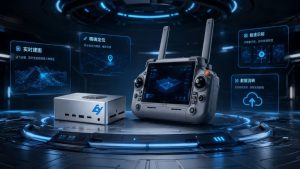
IceCypress TrackSight is a high-speed target tracking and analytics system that integrates multi-scenario calibration, object tracking, 6-DoF pose estimation, 4D deformation analysis, and full-process experiment management. It supports the motion tracking workflow from test design and calibration to synchronized analysis and report generation.
- Stable High-Speed Tracking
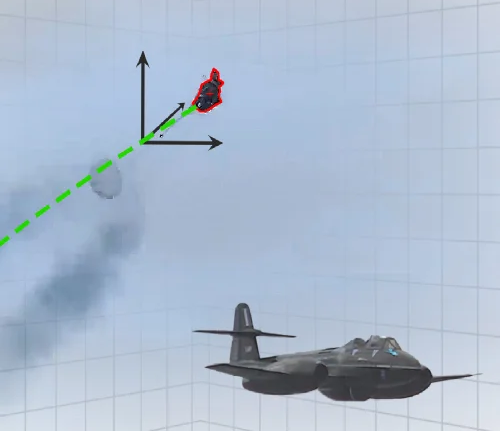
With object-tracking accuracy down to 0.3 pixels, TrackSight supports precise positioning and continuous tracking of fast-moving targets. It is designed to adapt to partial occlusion, glare, sudden lighting changes, low-light conditions, and low-resolution scenarios, supporting more complete data collection during high speed motion analysis.
- Flexible Calibration
The system provides five calibration algorithms, UAV RTK-assisted positioning, and calibration support for 300 mm telephoto lenses. These options allow teams to adapt calibration to laboratory, field, long-range, and aerial tests, while markerless tracking can reduce target-preparation requirements when physical markers are unsuitable.
- Higher Measurement Accuracy
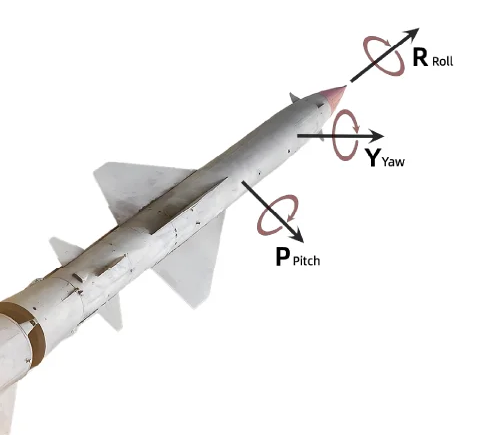
TrackSight supports real-time 6-DoF pose estimation with an orientation accuracy of below 0.5°. It also provides real-time contour extraction, with target edge recognition error below 1% in complex backgrounds, supporting the measurement of position, orientation, area, volume, deployment speed, and deformation.
- Integrated Analysis Workflow
TrackSight connects test design, automated camera planning, synchronized data analysis, and report generation within one workflow. Its integrated motion analysis software reduces manual data transfer and incorporates AI-driven markerless tracking into a coordinated validation process.
These capabilities make TrackSight a high-speed motion analysis system for teams that require precise trajectory, pose, contour, volume, and deformation data within one coordinated workflow.
Business Value of Upgrading Your Motion Tracking System
Technical performance matters when it contributes to productivity and decision quality. Procurement teams can evaluate an upgrade by considering four potential business outcomes.
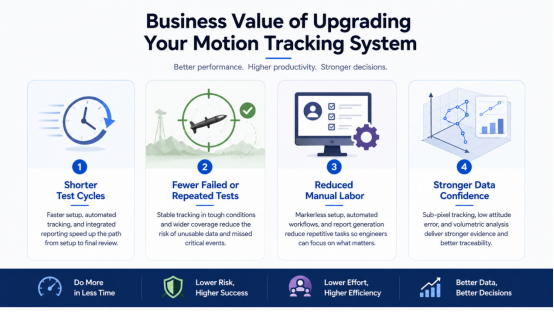
- Shorter Test Cycles:Faster calibration, automated tracking, and integrated reporting can reduce the time from setup to final review, allowing facilities to complete more work with the same resources.
- Fewer Failed or Repeated Tests: Stable high speed motion analysis under occlusion, glare, and low-resolution conditions reduces the risk of unusable data. Wider coverage also lowers the chance that a critical event falls outside the measurable volume.
- Reduced Manual Labor: Reduced marker preparation, automated camera planning, synchronized analysis, and report generation can limit repetitive work. This allows engineers to spend more time on data interpretation and result validation.
- Stronger Data Confidence: Sub-pixel tracking, low orientation error, and volumetric analysis can provide stronger evidence for technical decisions. Integrated motion analysis software also supports more efficient review and cross-checking across synchronized video, trajectory curves, 3D models, and technical reports.
Conclusion
An outdated motion tracking system can slow testing, reduce data quality, and increase the need for repeated work. Upgrading helps teams improve tracking reliability, measurement accuracy, workflow efficiency, and confidence in test results.
IceCypress TrackSight brings tracking, analysis, and reporting into one coordinated workflow for complex test environments.
Contact IceCypress to discuss whether TrackSight is the right fit for your motion analysis needs.
References
- NASA Technical Reports Server. Unobtrusive Monitoring of Sensorimotor Performance in Ground-Based Functional Tasks.
https://ntrs.nasa.gov/citations/20240010741