The rapid development of unmanned aerial technology is changing how organizations conduct surveillance, mapping, inspection, and emergency response missions. A single drone can provide valuable aerial data, but complex operational environments often require broader coverage, faster response, and higher reliability. This is where a multi-drone system becomes increasingly important, enabling multiple unmanned aerial vehicles to work together as an intelligent network.
At Icecypress Technology, we specialize in spatial intelligence AI solutions built on advanced 3D and artificial intelligence technologies. By combining autonomous drone collaboration, intelligent data processing, and real-time communication capabilities, we develop solutions that help organizations achieve more efficient aerial operations. Our BeeSmart Drone Swarm solution demonstrates how coordinated drone networks can support intelligent surveillance and large-scale mapping requirements.
What Is a Multi-Drone System and How Does It Work?
A multi-drone system refers to a coordinated network of multiple unmanned aerial vehicles that operate together to complete complex missions. Unlike traditional single-drone operations, this approach allows several drones to share tasks, collect data simultaneously, and respond to changing conditions through intelligent coordination.
The core advantage of a multi-drone system is scalability. Multiple drones can cover larger areas within shorter timeframes while reducing dependence on manual operation. Through artificial intelligence, communication networks, and autonomous control technologies, drone fleets can complete missions with improved efficiency and accuracy.
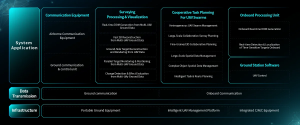
Our BeeSmart Drone Swarm solution is built around an intelligent architecture that combines an onboard intelligent unit, drone surveillance system collaborative network, and portable ground terminal. This structure creates an air-ground collaborative intelligent closed loop that supports mission planning, data collection, processing, and operational decision-making.
The Architecture Behind an Intelligent Multi-Drone System
A reliable multi-drone system requires several key components working together. The first component is the onboard intelligent unit, which provides each drone with real-time perception and processing capabilities. With onboard AI, drones can analyze collected information during flight instead of relying entirely on remote processing.
The second component is the drone surveillance system collaborative network. Through communication between multiple drones, the fleet can exchange information, coordinate movements, and maintain operational awareness. This network enables drones to work as a unified team rather than independent devices.
The third component is the portable ground terminal. It provides operators with mission control, monitoring capabilities, and data management functions. By connecting aerial platforms with ground-based management tools, the system supports complete mission workflows from preparation to final output.
Our solution also integrates airborne communication equipment, onboard real-time DOM generation, and an intelligent UAV management platform. This creates a unified drone fleet management system capable of supporting complex aerial missions without relying heavily on fixed infrastructure.
Key Use Cases of Multi-Drone Systems Across Industries
A multi-drone system provides significant value in scenarios that require wide-area monitoring, rapid information collection, or operations in challenging environments.
In defense and security applications, coordinated drone fleets can support intelligence, surveillance, and reconnaissance missions. Multiple drones can collect information from different angles, improve situational awareness, and provide faster responses in dynamic environments.
For mapping and surveying projects, multi-drone systems offer advantages in large-scale terrain data collection. Traditional surveying methods may require significant time and manpower, while coordinated drone operations can accelerate coverage and generate high-precision geographic data.
Emergency response is another important application area. During natural disasters, accidents, or infrastructure failures, drone fleets can quickly enter affected areas, provide real-time visual information, and support rescue planning without exposing personnel to unnecessary risks.
Industrial inspection also benefits from drone collaboration. Mining, energy, construction, and transportation companies can use drone networks to monitor large assets, identify potential issues, and improve operational safety.
How Drone Surveillance Systems Improve Real-Time Decision Making
A modern drone surveillance system is not limited to image collection. By integrating AI analysis and intelligent processing, it can transform raw aerial data into meaningful operational insights.
Our BeeSmart Drone Swarm solution combines perception, processing, and support capabilities into a complete closed loop. Powered by onboard AI and multi-drone collaboration, it enables centimeter-level precision and real-time response for both military and civilian missions.
One important advantage is reduced communication dependency. Traditional drone operations often rely on centralized infrastructure, which may create limitations in remote or challenging environments. Our system supports a centerless ad-hoc network, allowing drones to maintain collaboration even without extensive ground facilities.
This capability helps organizations perform missions in locations where communication conditions are limited while maintaining operational continuity and data accuracy.
Limitations and Challenges of Multi-Drone Deployment
Although multi-drone systems provide significant benefits, organizations must also consider several technical challenges. Managing multiple autonomous devices requires reliable communication, cutting edge algorithms, and strong cybersecurity protection.
Battery endurance remains another important consideration. Larger missions require careful flight planning, energy management, and coordination between drones to maintain continuous operations.
Data processing is also a challenge. A fleet of drones can generate large volumes of images, video, and geographic information. Without efficient AI processing and cloud integration, organizations may struggle to convert collected data into actionable insights.
At Icecypress Technology, we address these challenges by combining AI-powered processing, 3D spatial intelligence, and intelligent drone management technologies. Our approach focuses on creating efficient workflows that connect data collection, analysis, and decision support.
Creating the Future of Intelligent Aerial Operations
The evolution of drone technology is moving beyond individual aircraft toward intelligent, collaborative networks. As organizations demand faster responses, larger coverage areas, and more accurate information, multi-drone systems will continue becoming an essential tool for modern operations.
At Icecypress Technology, we are committed to developing spatial intelligence solutions that integrate drones, AI, and 3D technologies. Our BeeSmart Drone Swarm solution provides a foundation for intelligent surveillance, large-scale mapping, and autonomous aerial collaboration.
By combining a powerful drone surveillance system with multi-drone coordination capabilities, we help organizations improve operational efficiency, strengthen decision-making, and unlock new possibilities for intelligent air-ground collaboration.