Accident investigation depends on preserving reliable scene information before vehicles, debris, traffic conditions, or other evidence changes. Traditional documentation can involve photographs, videos, sketches, and manual measurements, but these records may not fully preserve spatial relationships. As investigation teams seek faster and more complete digital evidence, 3D reconstruction is becoming a practical part of modern accident investigation workflows. The real question in 2026 is not whether reconstruction is useful, but how quickly teams can obtain a usable model.
What Determines 3D Reconstruction Time?
The time required for a 3D crash scene reconstruction does not come from one processing step. It includes scene capture, data preparation, reconstruction, visualization, measurement, and output. Capture quality also matters because incomplete or inconsistent imagery can require additional processing or even another collection session.
For professional teams, this makes workflow design as important as computing power. An accident reconstruction APP or software solution that simplifies collection and processing can reduce operational friction while allowing investigators to focus on evidence rather than technical procedures.
Why Traditional Workflows Can Take Longer
Conventional accident documentation often relies on multiple methods. Investigators may photograph vehicles and road conditions, record measurements manually, create sketches, and later organize the information into reports. Each method provides useful evidence, but combining them can create additional work.
The physical scene can also become a constraint. Traffic needs to resume, damaged vehicles may be moved, and environmental conditions can change. A reconstruction workflow that captures the scene quickly therefore provides more than convenience. It helps preserve a digital representation that investigators can revisit after leaving the location.
How Fast Is 3D Reconstruction in 2026?
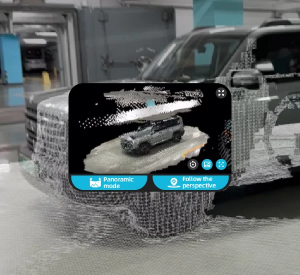
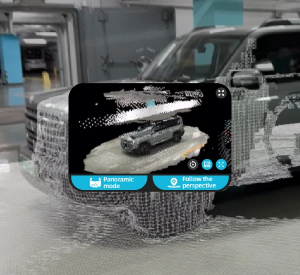
The answer depends on what teams mean by “reconstruction.” Rusa Rapid 3D Scene Reconstruction System from IceCypress Technology is designed around a three-step Collection–Processing–Output workflow. Its published capabilities include minute-level preview model export, allowing teams to check scene coverage quickly before leaving the site.
For high-precision applications, Rusa specifies reconstruction in 40 minutes or less. This provides a practical reference point for teams evaluating accident reconstruction tools, although the actual time for a particular case can vary according to captured data, scene complexity, and operational requirements.
Why Minute-Level Preview Matters
A preview model can be valuable even before the final high-precision reconstruction is complete. Investigators can use it to confirm whether important areas have been captured and whether the available imagery is sufficient. If a vehicle, road mark, obstacle, or other relevant feature is missing, the team has an opportunity to collect additional footage while still at the scene.
This creates a more efficient field workflow. Rather than discovering coverage problems after returning to the office, investigators can validate the digital scene earlier. For an accident reconstruction APP, this type of immediate feedback can be especially useful for frontline personnel working under time pressure.
Rusa Simplifies the Collection-to-Output Process
At IceCypress Technology, we designed Rusa to reduce unnecessary complexity in 3D scene reconstruction. The system does not require specialized professional equipment for capture, and its flexible frame extraction rate adapts to different shooting speeds and collection scenarios.
Our approach is intended to make the technology accessible to ordinary users while retaining high-precision capabilities. Once footage is collected, the system can generate a reconstructed scene without requiring tedious manual adjustments. This helps shorten the distance between field evidence and a usable digital model.
Accuracy Still Matters More Than Speed Alone
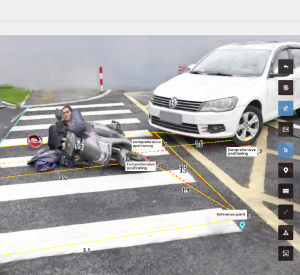
Fast reconstruction has limited value if investigators cannot measure the resulting scene reliably. Accident analysis frequently depends on distances, positions, areas, and relationships between objects. A visually convincing model therefore needs measurable spatial information.
Rusa provides measurement error of less than 2 cm, supporting measurements such as length, area, volume, true distance, and horizontal distance between points. Multiple points can also be measured simultaneously. These capabilities allow the reconstructed scene to function as a measurable digital record rather than simply a 3D visualization.
AI Helps Investigators Focus on Critical Evidence
Large accident scenes may contain many visual elements that are irrelevant to the investigation. Searching through every detail manually can increase analysis time. Rusa incorporates AI-based recognition to identify important ground features, including tires, obstacles, traffic signs, and road damage.
The system can also hide non-key features to reduce visual interference and highlight relevant objects. Importantly, AI does not determine liability. It helps investigators locate and organize information, while professional judgment remains responsible for interpreting evidence and determining what happened.
From Accident Scene to Reusable Digital Evidence
The value of reconstruction continues after investigators leave the road. A reusable 3D model allows teams to inspect the scene from different perspectives, perform measurements, and communicate spatial information more clearly. This can support accident analysis, emergency decisions, and liability-related investigations.
At IceCypress Technology, we extend the same spatial intelligence approach beyond traffic accidents to criminal investigations, cultural preservation, construction, and engineering. Our broader product portfolio includes Rusa, Mirauge3D, TrackSight, DroneSwarm, BeeSmart Drone Swarm, Hunter Wing, and our Low-Altitude 3D Intelligent Operations Platform.
Making Crash Reconstruction Faster and More Practical
For organizations evaluating modern accident reconstruction tools, speed should be assessed alongside accuracy, usability, and evidence preservation. A system that produces a quick preview but lacks precision may not meet professional requirements. Conversely, a highly accurate system that demands complicated field procedures may slow down real investigations.
We believe the stronger approach is an integrated workflow. Rusa combines accessible capture, minute-level preview, high-precision reconstruction in 40 minutes or less, AI-assisted recognition, high-fidelity visualization, and measurement accuracy below 2 cm. Together, these capabilities help transform accident scenes into practical digital evidence more efficiently.
Building a Faster Evidence Workflow for 2026
3D crash scene reconstruction no longer needs to be viewed as a lengthy specialist-only process. With streamlined capture and intelligent processing, teams can move from physical evidence to a digital scene within a substantially shorter operational window. At IceCypress Technology, we continue developing spatial intelligence solutions that connect real-world environments with actionable digital information. Rusa represents our effort to make accident reconstruction faster, measurable, and accessible for professional investigation teams.