Fast-moving objects leave little room for measurement error. Whether engineers are analyzing parachute deployment, automotive crash behavior, material deformation, or biomechanical movement, a useful dataset must capture motion clearly enough to reveal position, orientation, and changes over time. For us, effective high-speed object tracking is therefore not simply a matter of choosing a camera with a high frame rate. It requires the right combination of imaging, calibration, tracking algorithms, and spatial analysis.
Why High-Speed Object Tracking Requires More Than Fast Cameras
A high frame rate provides more observations per second, but it does not automatically guarantee accurate motion measurement. When an object moves rapidly during exposure, its image can spread across multiple pixels, producing motion blur. Exposure time, object velocity, camera resolution, and field of view all influence the resulting blur.
This means engineers designing a motion tracking system must consider the entire imaging chain. Frame rate determines how frequently the system samples movement, while exposure time determines how sharply each sample represents the target. Illumination, data transmission, processing, and storage also influence whether high-speed imaging produces usable measurements.
Choosing Frame Rates According to the Motion
Frame rate should be selected according to the event being measured rather than treated as an isolated specification. A slowly moving mechanism may not require extreme frame rates, while a projectile, crash event, rotating component, or rapidly deploying structure can change substantially between consecutive frames.
For high-speed applications, engineers can relate frame rate to the target’s velocity, field of view, and the number of observations required during the event. High-speed imaging references commonly use these factors to determine an appropriate recording rate rather than simply selecting the camera’s maximum available fps.
More frames can improve temporal resolution, but higher frame rates may also impose tighter exposure requirements and greater demands on data handling. The objective should therefore be sufficient temporal sampling combined with images sharp enough for the tracking algorithm to extract reliable features.
The Role of Algorithms in High-Speed Tracking
Camera performance provides the raw visual information, but algorithms turn those images into measurable trajectories. A modern high-speed object tracking workflow can identify targets, follow their movement across frames, maintain tracking under certain challenging visual conditions, and convert image coordinates into useful motion data.
Our TrackSight High-Speed Target Tracking & Analytics System is built around three analytical engines: high-speed object tracking, 6-DoF pose estimation, and 4D deformation reconstruction. The system integrates these engines with calibration and experiment-management functions to create a workflow extending from test preparation through analysis and validation.
Sub-Pixel Tracking Improves Measurement Resolution
Pixel-level localization can become limiting when engineers need to measure very small changes. TrackSight therefore uses sub-pixel object tracking with a minimum recognition accuracy of 0.3 pixels. The system can simultaneously track more than five targets and supports both marker-based and markerless recognition.
The distinction between these modes is useful for different testing environments. Marker-based tracking can provide high positional certainty for controlled and repeatable experiments, while markerless tracking uses AI-driven recognition of unmarked objects when attaching physical targets is impractical.
TrackSight is also designed to handle sudden lighting changes, partial occlusion, and low-resolution scenarios, with a published tracking recognition rate of up to 99.6%.
Why Camera Calibration Comes Before Tracking
Accurate tracking begins with accurate camera geometry. If multiple cameras observe an object from different positions, calibration establishes the relationships needed to transform image observations into consistent spatial measurements.
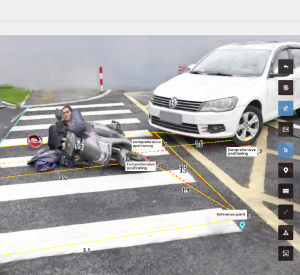
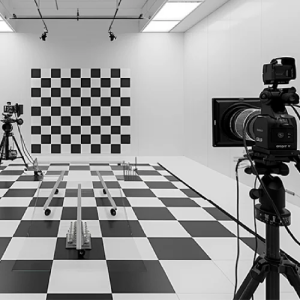
Our Multi-Scenario Camera Calibration System supports indoor laboratories, outdoor fields, and aerial monitoring. TrackSight provides five calibration algorithms: rotation calibration, checkerboard calibration, collinearity calibration, Direct Linear Transformation (DLT), and self-calibration. It also supports 300mm telephoto lens calibration outdoors without dedicated markers and UAV RTK-assisted aerial calibration with an error below 0.1m.
This flexibility helps organizations adapt one motion tracking system to different experimental environments rather than designing an entirely separate workflow for every test location.
Adding 6-DoF to Movement Analysis
Position alone does not fully describe how an object behaves. Engineers may also need to know how it rotates, tilts, or changes orientation while moving.
TrackSight provides real-time 6-DoF motion tracking covering X, Y, and Z position together with yaw, pitch, and roll. Its published attitude error is below 0.5°, while long-range calculation can extend to 200 meters. The system also supports weak-texture and small-target recognition and dynamic roll-angle calculation for applications such as projectile spin testing.
This additional spatial information can make test results more meaningful, particularly when rotational behavior is directly related to product performance or structural stability.
From Motion Trajectories to 4D Analysis
Some engineering problems require more than knowing where a target moves. Researchers may need to understand how its shape changes during deployment, impact, or deformation.
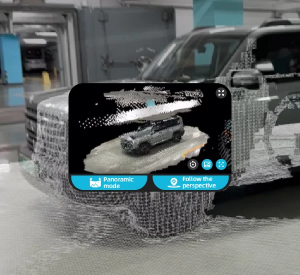
Our TrackSight system uses 3D motion analysis to extract contour features and quantify parameters such as area, volume, and deployment speed. Target-edge recognition error is specified at below 1% in complex backgrounds, while a three-camera minimum configuration supports volumetric measurements and 4D spatiotemporal deformation reconstruction.
This connects trajectory analysis with structural behavior, helping teams study dynamic processes instead of relying only on individual frames.
Building a More Complete Motion Measurement Workflow
High-speed measurement is ultimately a system-design challenge. Cameras, frame rates, exposure, calibration, algorithms, spatial reconstruction, and data management must work together to produce dependable results.
At IceCypress Technology, we developed TrackSight around that principle. By combining multi-scenario calibration, 0.3-pixel tracking, 6-DoF pose estimation, and 4D reconstruction, we help professional teams move from fast visual events to measurable engineering data. For aerospace, advanced manufacturing, biomechanics, and other demanding applications, this integrated motion tracking system provides a stronger foundation for research, testing, and validation.