Accident reconstruction is a detail-heavy process where every minute spent at the scene, measuring evidence, rebuilding models, or preparing reports can affect the cost of a case. Investigators must document roadway conditions, vehicle positions, marks, damage, and other evidence before analyzing what happened. Modern 3D technology can streamline these steps. At IceCypress Technology, we see potential ROI not only in equipment considerations, but also in reducing the time and manual effort required to move from scene documentation to usable reconstruction evidence.

Why Time Is a Major Reconstruction Cost
A crash investigation does not end when investigators leave the roadway. NHTSA describes crash investigation as a process involving scene inspection, vehicle inspection, interviews, photographs, and supporting records. Scene evidence can include skid or yaw marks, vehicle positions, impact information, and final rest locations.
That creates several potential sources of labor. Teams need to collect sufficient evidence, measure relevant features, organize the information, reconstruct spatial relationships, and communicate findings. When these steps rely heavily on manual workflows, complex cases can consume substantial staff time.
For organizations handling many cases, even modest savings per investigation can accumulate. If a tool reduces repeated measurements, simplifies scene review, or accelerates reconstruction, investigators can redirect those hours toward analysis and additional cases.
Moving Beyond Traditional Scene Measurement
Photogrammetry has already demonstrated its value in accident investigation. A Virginia Transportation Research Council review found that photography-based photogrammetry can reduce certain types of on-scene investigation time because photographs can be collected more quickly and simply than traditional coordinate and total-station surveying.
However, the same research also identified an important limitation: reducing field time can shift work into later analysis. That distinction matters when calculating ROI. A faster capture process is valuable only when the complete workflow—from collection through measurement and reporting—also becomes more efficient.
Modern accident reconstruction tools therefore need to minimize both field effort and downstream processing. The objective is a shorter case cycle, not simply a shorter visit to the accident scene.
AI Can Reduce the Search for Relevant Evidence
One advantage of modern 3D reconstruction is the ability to combine spatial modeling with AI-assisted recognition. Instead of forcing investigators to examine every visible element with equal attention, intelligent software can help isolate features that matter to the case.
Our Rusa Rapid 3D Scene Reconstruction System uses AI algorithms to automatically identify key ground features such as tires, obstacles, traffic signs, and road damage. It can also hide non-key features, helping investigators focus on relevant objects and reduce visual interference.
This workflow can help investigators focus on relevant scene elements by reducing visual interference and highlighting key objects. For teams managing multiple cases, this can reduce the amount of repetitive visual searching required during scene review.
Centimeter-Level Measurement Without Rebuilding the Scene
Measurement is another major component of accident reconstruction. Investigators may need to establish distances between vehicles, roadway features, marks, obstacles, or other evidence. Errors or missing measurements can create additional work if teams need to revisit the scene.
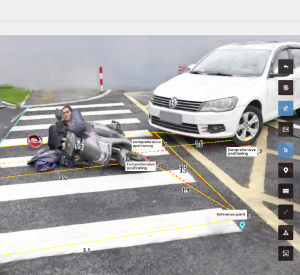
Rusa is designed to provide measurement error below 2 cm. The system supports length, area, volume, true or horizontal distances between two points, and simultaneous multi-point measurement.
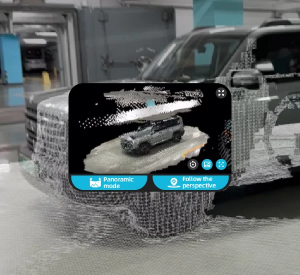
Its model browser allows users to zoom, drag, and rotate reconstructed scenes while displaying measurement values directly on the model. This creates a more intuitive way to inspect spatial relationships without relying exclusively on separate measurement notes.
For organizations evaluating accident reconstruction tools, this combination matters because the value lies in preserving measurable scene information that can be reviewed after field collection.
Faster Processing Changes the ROI Calculation
The economics of reconstruction software should include processing time, not just acquisition costs. A system that produces a usable model quickly can shorten the interval between collecting evidence and beginning detailed analysis.
IceCypress Technology designed Rusa around a three-step “Collection–Processing–Output” workflow. According to our product specifications, users can capture footage with ordinary devices, generate a preview model in minutes, and proceed toward refined reconstruction without requiring specialized professional equipment.
This approach can also reduce dependence on highly specialized field operators. The potential ROI comes from making more of the workflow repeatable and accessible, allowing organizations to allocate expert personnel where their judgment creates the greatest value.
Why Accident Investigation Software Should Support Reporting
A reconstruction is ultimately useful when its findings can be reviewed, communicated, and incorporated into the broader case. A technically accurate model that is difficult to share can create another bottleneck.
Rusa supports custom reports and multi-format exports, allowing reconstructed information and measurements to move into downstream workflows. This can help teams avoid recreating the same evidence in different formats for investigators, engineers, legal teams, or other stakeholders.
For buyers comparing accident investigation software, interoperability and reporting should therefore be considered alongside reconstruction speed. A practical system should help reduce manual work across the broader case workflow.
Measuring ROI in Hours Saved Per Case
We recommend that organizations evaluate ROI using their own workflow rather than assuming a universal savings figure. Start by recording average hours for field documentation, data processing, measurement, reconstruction, review, and report preparation.
Then compare those baseline figures with the same stages after deployment. If a system saves two hours per case and an organization handles hundreds of cases annually, the labor impact becomes measurable. Additional value may come from reduced repeat site visits, faster case turnaround, and better use of specialist staff.
This framework gives procurement teams a clearer business case than focusing solely on hardware or software purchase price.
Turning Faster Reconstruction Into Operational Value
Modern 3D reconstruction is changing accident investigation from a collection of photographs and measurements into a measurable digital scene. Research recognizes the potential of 3D technologies to provide accurate, reproducible documentation for accidents and other forensic applications.
At IceCypress Technology, we build on that direction with Rusa, combining AI recognition, high-fidelity reconstruction, and centimeter-level measurement in one workflow. The strongest ROI comes when every saved hour contributes to a faster, more consistent, and more scalable investigation process. For professional teams, that is the real value of modern accident reconstruction: less time spent rebuilding evidence, and more time spent understanding it.